


Ebike Academy 13: Advanced Pro Guide to Tuning Your Ebike Controller and BMS Parameters

For the ultimate enthusiast, an electric bike is not just a tool for transportation—it is a high-performance machine waiting to be fully unlocked. To transition into the Pro tier, you must move beyond plug-and-play accessories and dive into software calibration. By deep-tuning your ebike controller and establishing a smart connection with your battery, you can maximize raw power, throttle response, and regenerative braking.
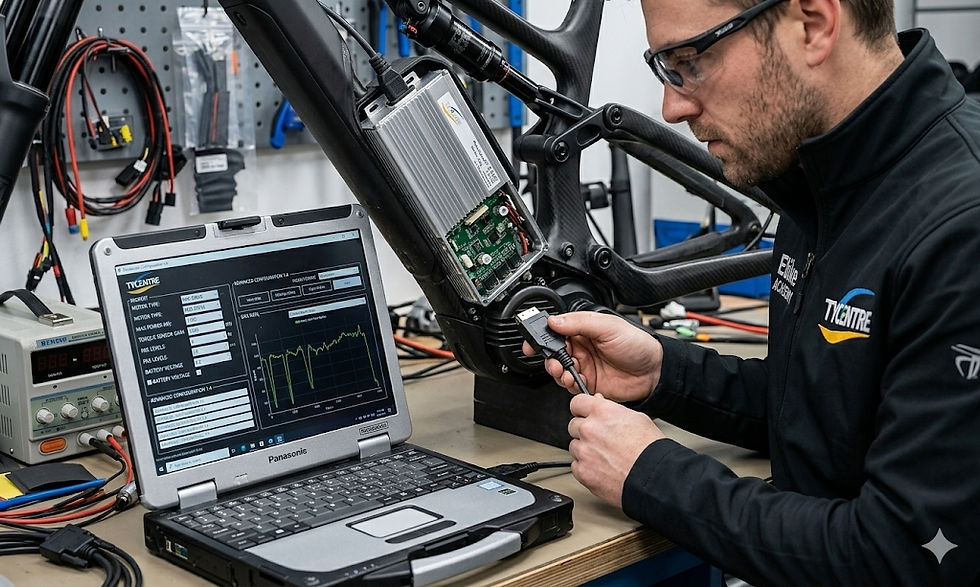
1. Unleashing Maximum Power via Ebike Controller Phase Current Calibration
The ebike controller acts as the gatekeeper of power. Adjusting its core parameter settings via bluetooth or a programming cable completely alters your ebike performance.
Rated vs. Peak Phase Current: Increasing the phase current delivers explosive low-end torque, perfect for sudden acceleration and steep trail climbs. However, this must be balanced to prevent overheating the ebike motor.
Field Weakening (Flux Weakening): Pro riders utilize field weakening settings in vector (FOC) controllers to extend the motor's RPM beyond its standard physical limits, effectively increasing your top end ebike speed.
2. Advanced Regenerative Braking and BMS Data Synchronization
A true enthusiast looks at energy as a closed-loop system. Properly configuring your smart ebike battery management system (BMS) and controller synchronization changes how your vehicle handles braking.
Regenerative Braking (Regen) Curve: Tuning the regen percentage allows the motor to act as a generator when you pull the brake levers, feeding energy back into your lithium ebike battery while saving your brake pads.
Smart BMS Monitoring: Utilizing a smartphone app connected to your battery's smart BMS allows you to monitor real-time cell voltage balance, discharge temperatures, and precise cycle counts to prevent voltage sag during high-amperage draws.

3. Throttle Response Curves and Torque Sensor Linearity
Raw power is useless without precise modulation. Advanced programming allows you to map how power is delivered relative to your physical input.
Exponential Throttle Mapping: Instead of a linear power delivery, pro players configure an exponential curve. This keeps the initial throttle smooth for tight technical maneuvers but delivers 100% power rapidly when twisted past the mid-point.
Torque Sensor Calibration: For pedal-assist enthusiasts, fine-tuning the millivolt response of the torque sensor ensures the ebike motor mirrors your physical pedaling power instantly with zero lag.
🛠️ Stuck on the road? Ebike Academy 12 teaches you how to be your own mechanic.

4. Engineering the Ultimate Ride with TYCENTRE VEHICLES
After you finish read Ebike Controller and BMS Parameters Tuning Guide, Understand deep parameter tuning requires a robust hardware foundation. At TYCENTRE VEHICLES, our comprehensive catalog—including high-voltage electric bikes, high-torque gas and electric quad ATVs, and heavy-duty mobility scooters—is built using highly programmable and resilient electronic architecture.
We embrace the DIY modification culture by offering excellent after-sales service and a premium selection of high-spec ebike spare parts, including unlocked controllers, high-discharge smart batteries, and heavy-duty wiring harnesses. With TYCENTRE, you have both the advanced hardware and the professional technical support to push your machine to its absolute engineering limits safely.


Comments